Buy gossips.eu ?
We are moving the project
gossips.eu .
Are you interested in purchasing the domain
gossips.eu ?
domain@kv-gmbh.de · 0541-91531010
Buy gossips.eu ?
'Third Reich persons'
The term "Third Reich persons" refers to individuals who were associated with the Nazi regime in Germany during the period of 1933 to 1945. These individuals were part of the government, military, or other organizations that supported Adolf Hitler's rule. They played a role in implementing the policies of the Third Reich, including the persecution of minorities, the outbreak of World War II, and the Holocaust. After the defeat of Nazi Germany in 1945, many of these individuals were tried for war crimes and crimes against humanity. **
Third Reich persons
The term "Third Reich persons" refers to individuals who were associated with or lived during the time of the Third Reich in Germany, which was the Nazi regime led by Adolf Hitler from 1933 to 1945. These individuals could include Nazi party members, government officials, military personnel, and civilians who lived under the rule of the Third Reich. The actions and beliefs of Third Reich persons have been widely studied and condemned due to the atrocities committed during this period, including the Holocaust and World War II. **

Similar search terms for Reich
Top-Angebote
Products related to Reich:
-
William Collins Nazi Billionaires: A Chilling Account Of Germany's Business Dynasties During The Third Reich - Non Fiction - PaperbackTitle:. Nazi Billionaires: A Chilling Account Of Germany's Business Dynasties During The Third Reich Format: Paperback Overview:. The history of Germany under the Third Reich is typically examined through military campaigns, political ideology, and humanitarian tragedy, yet the corporate infrastructure that sustained the entire apparatus remains critically important. This thoroughly researched investigation redirects attention toward the wealthiest industrial families and major manufacturing conglomerates that operated quietly behind the scenes during the war years. You will follow the financial trajectories of prominent business dynasties as they navigated state requisition, foreign trade embargoes, forced labour programmes, and aggressive contract bidding. Rather than delivering a surface-level overview, this volume unpacks how established companies protected their capital, leveraged wartime scarcity, and positioned themselves for future reconstruction. Drawing on declassified archives, internal corporate correspondence, and post-trial testimonies, the narrative reveals the practical mechanics of economic survival under a totalitarian regime. Each chapter systematically explores how technical expertise and financial networking merged with political compliance, demonstrating that business loyalty often shifted alongside shifting wartime fortunes. Presented in a clear, accessible paperback format, this work translates dense historical economics into a compelling chronological investigation that respects both scholarly standards and reader engagement. What Makes This Book Stand Out:. Traditional wartime histories frequently overlook the commercial mechanisms that kept factories operational, weapons assembly running at capacity, and luxury consumer sectors functioning for the elite. This book fills that gap by centreing the boardroom dynamics that directly influenced national mobilisation efforts. Instead of relying on broad generalisations, it provides granular case studies of specific corporations, detailing how leadership teams balanced profitability with moral consequences when state mandates demanded unquestioning cooperation. The author carefully separates verified corporate behaviour from post-war propaganda, revealing how executive decisions were made under intense legal and ideological pressure. Readers will encounter clear explanations of subsidy structures, joint ventures with military procurement agencies, and the systematic exploitation of occupied territories for raw materials. The forensic pacing ensures that complex financial arrangements never overwhelm the narrative arc, allowing audiences to trace cause and effect across decades. This methodological transparency makes the volume exceptionally useful for anyone wanting to understand how institutional wealth adaptation shaped modern European economic recovery. Who This Book Is Perfect For:. Academics and students studying twentieth-century European history, international trade...10,99 £*Shipping: 2,99 £Secure redirect to the provider
-
WH Allen Aftermath: Life in the Fallout of the Third Reich, 1945–1955 by Harald Jähner - Non Fiction - PaperbackTitle:. Aftermath: Life in the Fallout of the Third Reich Overview:. Aftermath: Life in the Fallout of the Third Reich, Harald Jähner’s sweeping history, asks how a nation rebuilds itself after the collapse of the Nazi regime. Spanning 1945 to 1955, the book threads together daily life, collective memory, and political reform as Germany faced occupation, scarcity, and rapid social change. Drawing on diaries, letters, newspapers, municipal records, and interviews, it shows how ordinary people repaired homes, restarted families, returned to work, and renegotiated a sense of national identity under the shadow of war crimes. It rises above a chronological inventory to offer a ground-level panorama of a society learning to live with the past while pursuing a future. Jähner’s prose is lucid, accessible, and vividly narrative, weaving intimate portraits with the larger economic and cultural forces at play. The book illuminates moments of upheaval—denazification, currency reform, the emergence of consumer culture, and the uneasy politics of memory—through the experiences of teachers, shopkeepers, farmers, performers, and officials. The result is both a compelling narrative and a deep, academically grounded exploration of how a country can redefine itself after catastrophe. A landmark work for readers who want a clear, human understanding of postwar Germany and how history reshapes everyday life. What Makes This Book Stand Out:. Where many histories of this era focus on leaders and policy, Aftermath centers the human experience. Jähner draws on a wide range of sources—personal diaries, letters, municipal records, and interviews—to illuminate the lived reality of a nation in flux. The book traces how people coped with rationing, rebuilt cities, navigated the denazification process, and reimagined culture in cinema, literature, radio, and art. Its strength lies in macro-scale insights anchored by micro-scale human detail: you feel what it was like to stand in a ruined courtyard, or to hear a new soundscape of Western radio after years of isolation. The writing is precise without being dry, and the narrative arc gives readers a satisfying sense of progress rather than mere nostalgia. The book’s reception—shortlisted for the Baillie Gifford Prize and winning the Leipzig Book Fair Prize, and its English translation by Shaun Whiteside—speaks to its accessibility and resonance across audiences. Who This Book Is Perfect For:. This book is ideal for readers who want a clear, human picture of postwar Germany, students studying modern Europe, and curious readers who enjoy narrative non-fiction. It will appeal to book clubs exploring memory and democracy, teachers building courses on 20th-century history, and anyone seeking context for how nations move from trauma to recovery. Its approachable prose makes it suitable for general readers as well as serious scholars; it rewards rereading with new details on home life, culture, and the politics of memory. If you love...14,99 £*Shipping: 2,99 £Secure redirect to the provider
-
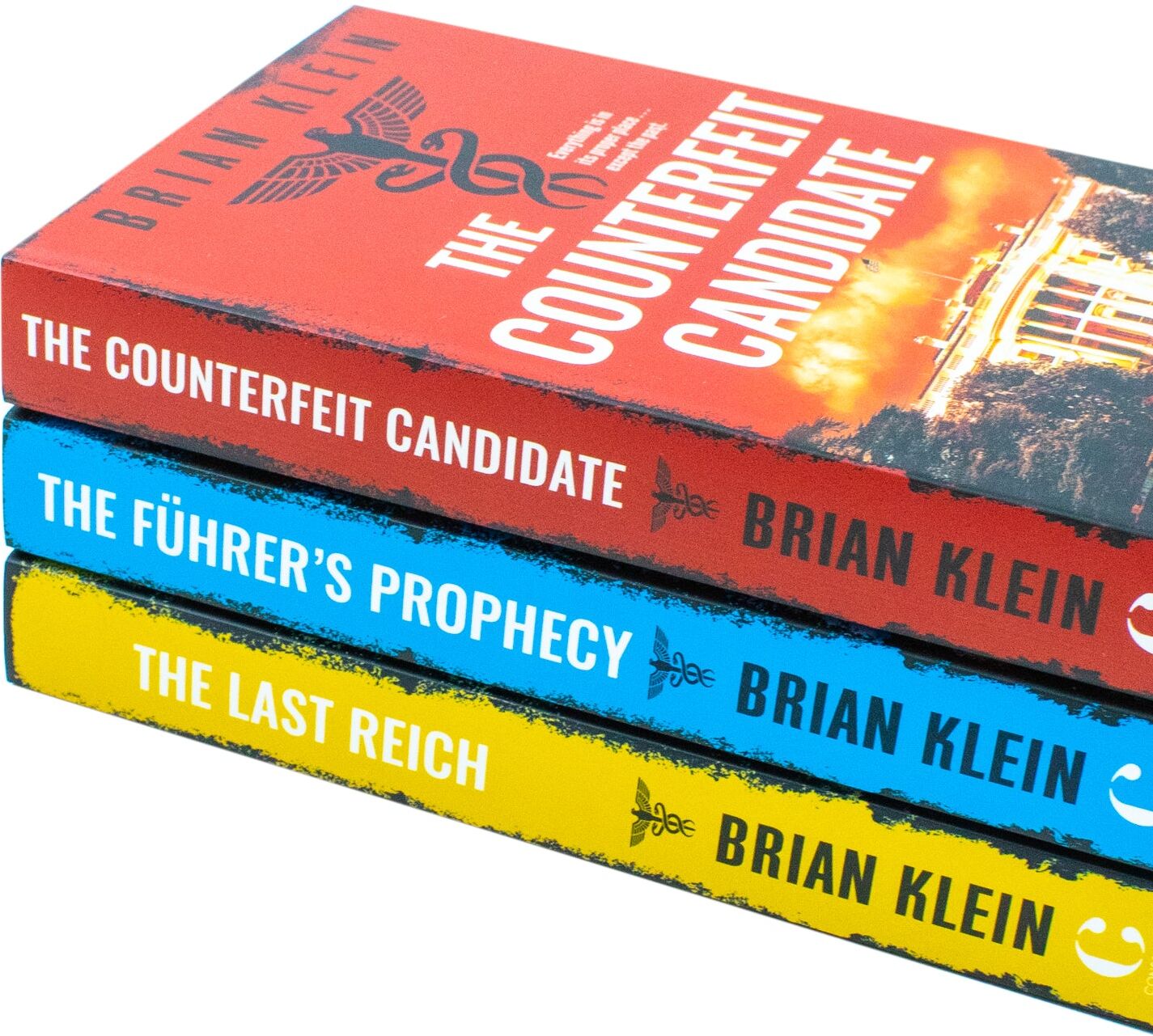
Constable Brian Klein Series 4 Books Collection Set (The Counterfeit Candidate, The Führer's Prophecy, The Last Reich, The Spider Covenant)Brian Klein Series 4 Books Collection Set (The Counterfeit Candidate, The Führer's Prophecy, The Last Reich, The Spider Covenant): The Counterfeit Candidate: Berlin, 30 April, 1945.As the Russian Army closes in on the war-torn City, Adolf Hitler and Eva Braun take their own lives. Their bodies are burned and buried in the Reich Chancellery garden, above the Führer's bunker.Buenos Aires, 9 January, 2012.Three audacious thieves carry out the biggest safe depository heist in Argentine history, escaping with more than one hundred million dollars' worth of valuables. Within hours, an encrypted phone call to America triggers a blood-soaked manhunt as the thieves are tracked down, systematically tortured, then murdered. The Führer’s Prophecy: January, 1939.Adolf Hitler makes an infamous speech at the Reichstag threatening 'the annihilation of the Jewish race in Europe'. This vile public proclamation is seized upon by his fanatical supporters who christen it 'The Führer's Prophecy'.November, 1943.A sinister plot hatched inside Block 10 of the notorious Auschwitz deathcamp is known only to a handful of Nazis as Operation Gesamtkunstwerk. The Last Reich: A heinous, co-ordinated plot to attack a series of prominent synagogues, located across five different continents, is scheduled to take place on Yom Kippur - the Jewish Day of Atonement. For that one day of the year, celebrated prayer houses will be packed to the rafters with Jewish worshippers and the results could prove to be devastating. The mastermind behind the attacks is a direct blood descendant of Adolf Hitler - his grandson, former Republican presidential candidate, John Franklin. The Spider Covenant: On 10 August 1944, with Germany on the verge of a crushing and humiliating defeat, Heinrich Himmler, the second most powerful Nazi and head of the notorious SS, holds a clandestine meeting in Strasbourg, with a handful of elite industrialists and bankers. A covert organisation is born, codenamed 'Die Spinne' - The Spider. The network is tasked with helping senior SS officers escape the clutches of advancing allied forces. New identities are created, bankrolled by illicit funds, allowing notorious criminals to begin new lives in Europe and South America. Many of them land key roles in the worlds of politics, banking and industry. Decades later, they're able to pass on a privileged and influential birth right to their descendants.18,99 £*Shipping: 2,99 £Secure redirect to the provider
-
Cal Exotics, Scandal Scandal Full Length Body SuitSuit Up For Scandalous Seduction! Crotchless for easy-access play. Flaunt every inch of your fabulous figure in this stunning full-length mesh and lace bodysuit. Let its hypnotic geometric patterns cast a sexy spell on your lover. The super-stretchy...39,99 $*Shipping: 0,00 $Secure redirect to the provider



-
'Third Reich Figures'
The term "Third Reich Figures" typically refers to prominent individuals who played key roles in the Nazi regime during Adolf Hitler's rule in Germany from 1933 to 1945. These figures include Hitler himself, as well as other high-ranking officials such as Joseph Goebbels, Heinrich Himmler, and Hermann Göring. They were responsible for implementing and enforcing Nazi policies, including the persecution of Jews and other minority groups, as well as the outbreak of World War II. Their actions and decisions had a profound impact on the course of history and resulted in immense suffering and devastation. **
-
'Third Reich people'
"Third Reich people" refers to individuals who lived in Germany during the time of Nazi rule, from 1933 to 1945. These people were influenced by the ideology of the Nazi party, which promoted extreme nationalism, anti-Semitism, and authoritarianism. Many Germans supported the regime, while others were coerced or oppressed into compliance. The actions of Third Reich people had a profound impact on the course of history, leading to World War II and the Holocaust. **
-
Third Reich individuals
Third Reich individuals refer to people who were part of the Nazi regime in Germany from 1933 to 1945. These individuals were supporters, members, or officials of the Nazi Party led by Adolf Hitler. They played various roles in implementing the policies of the Third Reich, including carrying out acts of discrimination, persecution, and violence against minority groups, as well as participating in military campaigns during World War II. After the defeat of the Third Reich in 1945, many of these individuals faced prosecution for their roles in the atrocities committed during this period. **
-
'Third Reich People'
"Third Reich People" refers to individuals who lived in Germany during the time of Nazi rule under Adolf Hitler from 1933 to 1945. These people were part of a society that was heavily influenced by Nazi propaganda, ideology, and policies. Many were supporters of the regime, while others may have been bystanders or victims of its atrocities. The term can also refer to those who were members of the Nazi Party, the military, or other organizations associated with the Third Reich. **


Third Reich Figures
The term "Third Reich Figures" typically refers to key individuals who played significant roles in the Nazi regime during Adolf Hitler's rule in Germany from 1933 to 1945. These figures include Hitler himself, as well as high-ranking officials such as Joseph Goebbels, Heinrich Himmler, Hermann Göring, and Rudolf Hess. Each of these individuals held positions of power within the Nazi government and were responsible for implementing policies that led to the atrocities committed during World War II, including the Holocaust. Their actions and ideologies continue to be studied and condemned as examples of the dangers of authoritarianism and extremism. **
How is it correctly written: das Reich sein, or das Reich sein, or das Reich sein?
The correct way to write it is "das Reich sein." In German, the verb "sein" (to be) is usually placed at the end of the sentence when used in the present tense. Therefore, the correct word order is "das Reich" (the empire) followed by the verb "sein" at the end. **
Top-Angebote
Products related to Reich:
-
Constable The Reich Trilogy 3 Books Collection Set By Brian Klein (The Counterfeit Candidate, The Führer's Prophecy and The Last Reich)The Reich Trilogy 3 Books Collection Set By Brian Klein (The Counterfeit Candidate, The Führer’s Prophecy & The Last Reich): The Counterfeit Candidate: Berlin, 30 April, 1945.As the Russian Army closes in on the war-torn City, Adolf Hitler and Eva Braun take their own lives. Their bodies are burned and buried in the Reich Chancellery garden, above the Führer's bunker.Buenos Aires, 9 January, 2012.Three audacious thieves carry out the biggest safe depository heist in Argentine history, escaping with more than one hundred million dollars' worth of valuables. Within hours, an encrypted phone call to America triggers a blood-soaked manhunt as the thieves are tracked down, systematically tortured, then murdered. The Führer’s Prophecy: January, 1939.Adolf Hitler makes an infamous speech at the Reichstag threatening 'the annihilation of the Jewish race in Europe'. This vile public proclamation is seized upon by his fanatical supporters who christen it 'The Führer's Prophecy'.November, 1943.A sinister plot hatched inside Block 10 of the notorious Auschwitz deathcamp is known only to a handful of Nazis as Operation Gesamtkunstwerk. The Last Reich: A heinous, co-ordinated plot to attack a series of prominent synagogues, located across five different continents, is scheduled to take place on Yom Kippur - the Jewish Day of Atonement. For that one day of the year, celebrated prayer houses will be packed to the rafters with Jewish worshippers and the results could prove to be devastating. The mastermind behind the attacks is a direct blood descendant of Adolf Hitler - his grandson, former Republican presidential candidate, John Franklin.9,90 £*Shipping: 2,99 £Secure redirect to the provider
-
Rowan Rook and Decard Eat the Reich Character and Map Pack - Green/Blue/WhiteBring the vampire-hunting adventure of Eat the Reich to the table with this character and map pack featuring the updated artwork edition. This pack provides printed play materials designed to support your group during the game, helping players keep important information close at hand without repeatedly referring to the main book. What’s included: - Three copies of each of the six character sheets - Three copies of the Inaccurate Map of Paris - Six rules reference sheets - Printable versions of all included sheets available as downloads The character sheets include space for notes, while the map supports the Paris-based adventure and gives the group a shared visual reference during play. The rules reference sheets help players check key game information quickly. This pack is a practical addition for groups who want extra printed materials for a new campaign, a larger party, or replacement copies. Compatible game: Eat the Reich tabletop role-playing game.9,99 £*Shipping: 3,95 £Secure redirect to the provider
-
William Collins Nazi Billionaires: A Chilling Account Of Germany's Business Dynasties During The Third Reich - Non Fiction - PaperbackTitle:. Nazi Billionaires: A Chilling Account Of Germany's Business Dynasties During The Third Reich Format: Paperback Overview:. The history of Germany under the Third Reich is typically examined through military campaigns, political ideology, and humanitarian tragedy, yet the corporate infrastructure that sustained the entire apparatus remains critically important. This thoroughly researched investigation redirects attention toward the wealthiest industrial families and major manufacturing conglomerates that operated quietly behind the scenes during the war years. You will follow the financial trajectories of prominent business dynasties as they navigated state requisition, foreign trade embargoes, forced labour programmes, and aggressive contract bidding. Rather than delivering a surface-level overview, this volume unpacks how established companies protected their capital, leveraged wartime scarcity, and positioned themselves for future reconstruction. Drawing on declassified archives, internal corporate correspondence, and post-trial testimonies, the narrative reveals the practical mechanics of economic survival under a totalitarian regime. Each chapter systematically explores how technical expertise and financial networking merged with political compliance, demonstrating that business loyalty often shifted alongside shifting wartime fortunes. Presented in a clear, accessible paperback format, this work translates dense historical economics into a compelling chronological investigation that respects both scholarly standards and reader engagement. What Makes This Book Stand Out:. Traditional wartime histories frequently overlook the commercial mechanisms that kept factories operational, weapons assembly running at capacity, and luxury consumer sectors functioning for the elite. This book fills that gap by centreing the boardroom dynamics that directly influenced national mobilisation efforts. Instead of relying on broad generalisations, it provides granular case studies of specific corporations, detailing how leadership teams balanced profitability with moral consequences when state mandates demanded unquestioning cooperation. The author carefully separates verified corporate behaviour from post-war propaganda, revealing how executive decisions were made under intense legal and ideological pressure. Readers will encounter clear explanations of subsidy structures, joint ventures with military procurement agencies, and the systematic exploitation of occupied territories for raw materials. The forensic pacing ensures that complex financial arrangements never overwhelm the narrative arc, allowing audiences to trace cause and effect across decades. This methodological transparency makes the volume exceptionally useful for anyone wanting to understand how institutional wealth adaptation shaped modern European economic recovery. Who This Book Is Perfect For:. Academics and students studying twentieth-century European history, international trade...10,99 £*Shipping: 2,99 £Secure redirect to the provider
-
WH Allen Aftermath: Life in the Fallout of the Third Reich, 1945–1955 by Harald Jähner - Non Fiction - PaperbackTitle:. Aftermath: Life in the Fallout of the Third Reich Overview:. Aftermath: Life in the Fallout of the Third Reich, Harald Jähner’s sweeping history, asks how a nation rebuilds itself after the collapse of the Nazi regime. Spanning 1945 to 1955, the book threads together daily life, collective memory, and political reform as Germany faced occupation, scarcity, and rapid social change. Drawing on diaries, letters, newspapers, municipal records, and interviews, it shows how ordinary people repaired homes, restarted families, returned to work, and renegotiated a sense of national identity under the shadow of war crimes. It rises above a chronological inventory to offer a ground-level panorama of a society learning to live with the past while pursuing a future. Jähner’s prose is lucid, accessible, and vividly narrative, weaving intimate portraits with the larger economic and cultural forces at play. The book illuminates moments of upheaval—denazification, currency reform, the emergence of consumer culture, and the uneasy politics of memory—through the experiences of teachers, shopkeepers, farmers, performers, and officials. The result is both a compelling narrative and a deep, academically grounded exploration of how a country can redefine itself after catastrophe. A landmark work for readers who want a clear, human understanding of postwar Germany and how history reshapes everyday life. What Makes This Book Stand Out:. Where many histories of this era focus on leaders and policy, Aftermath centers the human experience. Jähner draws on a wide range of sources—personal diaries, letters, municipal records, and interviews—to illuminate the lived reality of a nation in flux. The book traces how people coped with rationing, rebuilt cities, navigated the denazification process, and reimagined culture in cinema, literature, radio, and art. Its strength lies in macro-scale insights anchored by micro-scale human detail: you feel what it was like to stand in a ruined courtyard, or to hear a new soundscape of Western radio after years of isolation. The writing is precise without being dry, and the narrative arc gives readers a satisfying sense of progress rather than mere nostalgia. The book’s reception—shortlisted for the Baillie Gifford Prize and winning the Leipzig Book Fair Prize, and its English translation by Shaun Whiteside—speaks to its accessibility and resonance across audiences. Who This Book Is Perfect For:. This book is ideal for readers who want a clear, human picture of postwar Germany, students studying modern Europe, and curious readers who enjoy narrative non-fiction. It will appeal to book clubs exploring memory and democracy, teachers building courses on 20th-century history, and anyone seeking context for how nations move from trauma to recovery. Its approachable prose makes it suitable for general readers as well as serious scholars; it rewards rereading with new details on home life, culture, and the politics of memory. If you love...14,99 £*Shipping: 2,99 £Secure redirect to the provider
-
'Third Reich persons'
The term "Third Reich persons" refers to individuals who were associated with the Nazi regime in Germany during the period of 1933 to 1945. These individuals were part of the government, military, or other organizations that supported Adolf Hitler's rule. They played a role in implementing the policies of the Third Reich, including the persecution of minorities, the outbreak of World War II, and the Holocaust. After the defeat of Nazi Germany in 1945, many of these individuals were tried for war crimes and crimes against humanity. **
-
Third Reich persons
The term "Third Reich persons" refers to individuals who were associated with or lived during the time of the Third Reich in Germany, which was the Nazi regime led by Adolf Hitler from 1933 to 1945. These individuals could include Nazi party members, government officials, military personnel, and civilians who lived under the rule of the Third Reich. The actions and beliefs of Third Reich persons have been widely studied and condemned due to the atrocities committed during this period, including the Holocaust and World War II. **
-
'Third Reich Figures'
The term "Third Reich Figures" typically refers to prominent individuals who played key roles in the Nazi regime during Adolf Hitler's rule in Germany from 1933 to 1945. These figures include Hitler himself, as well as other high-ranking officials such as Joseph Goebbels, Heinrich Himmler, and Hermann Göring. They were responsible for implementing and enforcing Nazi policies, including the persecution of Jews and other minority groups, as well as the outbreak of World War II. Their actions and decisions had a profound impact on the course of history and resulted in immense suffering and devastation. **
-
'Third Reich people'
"Third Reich people" refers to individuals who lived in Germany during the time of Nazi rule, from 1933 to 1945. These people were influenced by the ideology of the Nazi party, which promoted extreme nationalism, anti-Semitism, and authoritarianism. Many Germans supported the regime, while others were coerced or oppressed into compliance. The actions of Third Reich people had a profound impact on the course of history, leading to World War II and the Holocaust. **
Similar search terms for Reich
-
Constable Brian Klein Series 4 Books Collection Set (The Counterfeit Candidate, The Führer's Prophecy, The Last Reich, The Spider Covenant)Brian Klein Series 4 Books Collection Set (The Counterfeit Candidate, The Führer's Prophecy, The Last Reich, The Spider Covenant): The Counterfeit Candidate: Berlin, 30 April, 1945.As the Russian Army closes in on the war-torn City, Adolf Hitler and Eva Braun take their own lives. Their bodies are burned and buried in the Reich Chancellery garden, above the Führer's bunker.Buenos Aires, 9 January, 2012.Three audacious thieves carry out the biggest safe depository heist in Argentine history, escaping with more than one hundred million dollars' worth of valuables. Within hours, an encrypted phone call to America triggers a blood-soaked manhunt as the thieves are tracked down, systematically tortured, then murdered. The Führer’s Prophecy: January, 1939.Adolf Hitler makes an infamous speech at the Reichstag threatening 'the annihilation of the Jewish race in Europe'. This vile public proclamation is seized upon by his fanatical supporters who christen it 'The Führer's Prophecy'.November, 1943.A sinister plot hatched inside Block 10 of the notorious Auschwitz deathcamp is known only to a handful of Nazis as Operation Gesamtkunstwerk. The Last Reich: A heinous, co-ordinated plot to attack a series of prominent synagogues, located across five different continents, is scheduled to take place on Yom Kippur - the Jewish Day of Atonement. For that one day of the year, celebrated prayer houses will be packed to the rafters with Jewish worshippers and the results could prove to be devastating. The mastermind behind the attacks is a direct blood descendant of Adolf Hitler - his grandson, former Republican presidential candidate, John Franklin. The Spider Covenant: On 10 August 1944, with Germany on the verge of a crushing and humiliating defeat, Heinrich Himmler, the second most powerful Nazi and head of the notorious SS, holds a clandestine meeting in Strasbourg, with a handful of elite industrialists and bankers. A covert organisation is born, codenamed 'Die Spinne' - The Spider. The network is tasked with helping senior SS officers escape the clutches of advancing allied forces. New identities are created, bankrolled by illicit funds, allowing notorious criminals to begin new lives in Europe and South America. Many of them land key roles in the worlds of politics, banking and industry. Decades later, they're able to pass on a privileged and influential birth right to their descendants.18,99 £*Shipping: 2,99 £Secure redirect to the provider
-
Cal Exotics, Scandal Scandal Full Length Body SuitSuit Up For Scandalous Seduction! Crotchless for easy-access play. Flaunt every inch of your fabulous figure in this stunning full-length mesh and lace bodysuit. Let its hypnotic geometric patterns cast a sexy spell on your lover. The super-stretchy...39,99 $*Shipping: 0,00 $Secure redirect to the provider
-
Sirius Dice Golden Buzz Animal Dice Set - Yellow - Golden BuzzAdd a bright touch of personality to tabletop games with the Sirius Dice Golden Buzz Animal Dice Set. The set features vibrant yellow polyhedral dice with bold red numbering, creating a distinctive bee-inspired colour combination that is easy to spot during play. Designed for role-playing games and other tabletop adventures, these dice provide the range of polyhedral shapes needed for a variety of common game mechanics. The contrasting red markings are clear against the yellow surfaces, helping players read their results at a glance. Key Features: - Yellow polyhedral dice with red numbering - Bee-inspired Golden Buzz colour scheme - Suitable for tabletop role-playing games - Designed for clear result visibility - Supplied as one consumer dice set Product Details: Brand: Sirius Dice Range: Animal Dice Colourway: Golden Buzz Product type: Polyhedral dice set14,99 £*Shipping: 3,95 £Secure redirect to the provider
-
Third Reich individuals
Third Reich individuals refer to people who were part of the Nazi regime in Germany from 1933 to 1945. These individuals were supporters, members, or officials of the Nazi Party led by Adolf Hitler. They played various roles in implementing the policies of the Third Reich, including carrying out acts of discrimination, persecution, and violence against minority groups, as well as participating in military campaigns during World War II. After the defeat of the Third Reich in 1945, many of these individuals faced prosecution for their roles in the atrocities committed during this period. **
-
'Third Reich People'
"Third Reich People" refers to individuals who lived in Germany during the time of Nazi rule under Adolf Hitler from 1933 to 1945. These people were part of a society that was heavily influenced by Nazi propaganda, ideology, and policies. Many were supporters of the regime, while others may have been bystanders or victims of its atrocities. The term can also refer to those who were members of the Nazi Party, the military, or other organizations associated with the Third Reich. **
-
Third Reich Figures
The term "Third Reich Figures" typically refers to key individuals who played significant roles in the Nazi regime during Adolf Hitler's rule in Germany from 1933 to 1945. These figures include Hitler himself, as well as high-ranking officials such as Joseph Goebbels, Heinrich Himmler, Hermann Göring, and Rudolf Hess. Each of these individuals held positions of power within the Nazi government and were responsible for implementing policies that led to the atrocities committed during World War II, including the Holocaust. Their actions and ideologies continue to be studied and condemned as examples of the dangers of authoritarianism and extremism. **
-
How is it correctly written: das Reich sein, or das Reich sein, or das Reich sein?
The correct way to write it is "das Reich sein." In German, the verb "sein" (to be) is usually placed at the end of the sentence when used in the present tense. Therefore, the correct word order is "das Reich" (the empire) followed by the verb "sein" at the end. **
* All prices are inclusive of VAT and, if applicable, plus shipping costs. The offer information is based on the details provided by the respective shop and is updated through automated processes. Real-time updates do not occur, so deviations can occur in individual cases. ** Note: Parts of this content were created by AI.