Buy gossips.eu ?
We are moving the project
gossips.eu .
Are you interested in purchasing the domain
gossips.eu ?
domain@kv-gmbh.de · 0541-91531010
Buy gossips.eu ?
What does "j'ai pas" or "je ne sais pas" mean?
"J'ai pas" is a colloquial way of saying "I don't have" in French, where the word "pas" replaces the word "de." On the other hand, "je ne sais pas" means "I don't know." Both phrases are commonly used in everyday conversations in French-speaking countries. **
What is the difference between c'est pas and ce n'est pas?
The difference between "c'est pas" and "ce n'est pas" lies in their formality. "C'est pas" is a colloquial and informal way of saying "it's not" in French, while "ce n'est pas" is the formal and standard way of expressing the same idea. "C'est pas" is commonly used in spoken language and informal writing, while "ce n'est pas" is more appropriate for formal writing and polite speech. **


Similar search terms for Champagne-Pas-Dosé-Réserve
Top-Angebote
Products related to Champagne-Pas-Dosé-Réserve:
-
Franciacorta Pas Dosé 'Sublimis' Uberti 2019The Sublimis Pas Dosé is the splendid interpretation of Franciacorta by the Umberti winery. Even from the name, one can sense the quality of these bubbles, created by those who have been present in the area since the Eighteenth century, like the Uberti family. The winery dates back to much more recent times when, in 1978, Agostino Uberti made his first vintage, then destined for the production of the Metodo Classico. In thirty-five years of history, the winery has gained experience and, just as then, Agostino along with his wife and daughters manages the vineyards with great care. Mechanical weeding and only natural fertilization help to keep intact the precious qualities of the soils of Erbusco, thus contributing to create some of the richest and most complex wines that the denomination can boast. Like the Franciacorta Sublimis Pas Dosé, born from carefully selected grapes, a model of indomitable elegance capable of providing tastings of the highest level. The emblem depicted on the label, in which the starry sky is precious preserved in a frameof gold, is a tribute to the night freshness that gives the chardonnay grapes a perfect ripening, making them shine in the sun with their perfectly golden berries. With a fine and refined perlage, the Franciacorta Sublimis Pas Dosé Umberti is majestically intense: it conquers with its noble balance in which a rainbow of aromas parades on the palate without ever ceasing to amaze. A wonderful expression of the Franciacorta territory.49,00 £*Shipping: 48,00 £Secure redirect to the provider
-
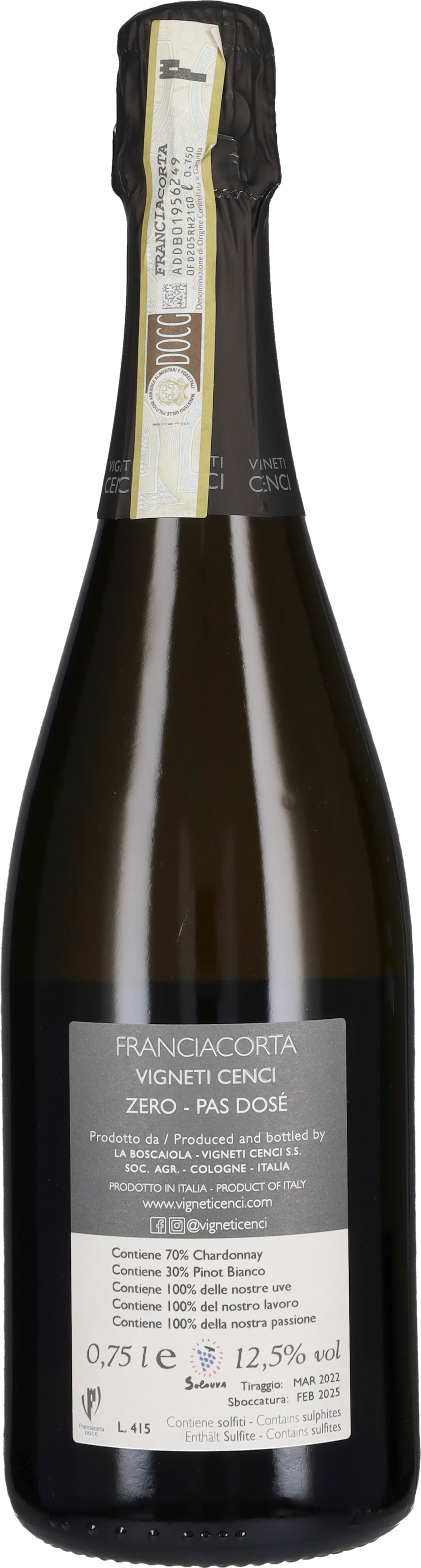
Franciacorta Pas Dosé Zero Vigneti CenciVigneti Cenci's Franciacorta Pas Dosé Zero is a bubbly with a dry and taut style, an expression of great purity being produced without any dosage. The headquarters of the winery is La Boscaiola, a beautiful 17th-century farmhouse located within the municipality of Cologne, at the south-western end of the Franciacorta production area. In this area, characterised by excellent exposure, an ideal microclimate for the cultivation of vines and soils particularly rich in mineral substances, wine production has always represented an activity of primary importance, carried on today by Giuliana Cenci together with her son Maurizio Bassi.Pas Dosé Zero Vigneti Cenci Franciacorta originates from a blend of Chardonnay (70%) and Pinot Bianco (30%) grapes grown within the municipality of Cologne, specifically on the slope of Monte Orfano. The soil is formed by an ancient, stepped colluvial layer on a rocky substratum of conglomerate gravels while the exposure is south-west. In the cellar, the grapes are vinified by soft pressing and subsequent alcoholic fermentation of the must at a controlled temperature. This is followed by re-fermentation in the bottle according to the Metodo Classico, using only sugars from the grapes rather than exogenous sugars. After at least 36 months of maturation on the lees, the sparkling wine is finally disgorged and then topped up with the same wine, without any dosage.Franciacorta Vigneti Cenci Pas Dosé Zero has a straw-yellow colour with greenish highlights and subtle effervescence. The nose has pleasant aromas of citrus fruits such as grapefruit and citron, supported by notes of pear and wisteria and a fine iodine mineral vein. Very savoury and energetic on the palate, characterised by an almost citrine freshness and a taut, distinctly mineral finish.28,00 £*Shipping: 48,00 £Secure redirect to the provider
-
Spumante Metodo Classico Pas Dosé Kettmeir 2021Lo Spumante Metodo Classico Pas Dosé della cantina altoatesina Kettmeir è un’etichetta che ben rappresenta il carattere del territorio. Ha la particolarità di essere realizzato con una percentuale molto elevata di Pinot Bianco, che dona un carattere di originale morbidezza ed eleganza, integrata da Chardonnay e da una piccola percentuale di Pinot Nero. Proprio la composizione dell’assemblaggio, la perfetta maturità delle uve e il lungo affinamento sur lattes, consente di realizzare un dosaggio zero armonioso e di grande equilibrio gustativo. Il Metodo Classico Pas Dosé nasce grazie all’esperienza di una cantina storica dell’Alto Adige. Kettmeir si trova nella zona di Caldaro e gestisce circa 50 ettari di vigneti in diverse aree del territorio altoatesino. Le uve di Pinot Bianco, Chardonnay e Pinot Nero provengono da vigneti aziendali coltivati sulle alte colline dell’Oltradige e della Bassa Atesina, a un’altitudine compresa tra i 380 e i 700 metri sul livello del mare. Il clima è fresco, connotato da importanti escursioni termiche tra le giornate soleggiate e le notti fredde. I terreni sono prevalentemente di natura calcarea, con presenza di argilla e molto ricchi di scheletro. Al termine della vendemmia, le uve sono sottoposte a refrigerazione per una notte e quindi alla vinificazione, che avviene separatamente per ogni vitigno. I grappoli sono pressati in modo molto delicato e il mosto fiore fermenta in vasche d’acciaio inox a temperatura controllata. I vini base maturano in acciaio fino alla primavera successiva, quando viene creata la cuvée definitiva. La seconda fermentazione si svolge in bottiglia secondo il Metodo Classico, con un affinamento sui lieviti di almeno 40 mesi. Il Pas Dosé Metodo Classico di Kettmeir è uno Spumante dal profilo verticale, teso e austero, ideale per chi ama soprattutto la limpida freschezza minerale. Nel calice si presenta con una veste di colore giallo paglierino con leggeri riflessi dorati e un perlage sottile, delicato e persistente. Il bouquet è elegante e raffinato, con fragranze agrumate, sfumature di fiori bianchi, aromi di frutta a polpa bianca, mela verde, pesca, cenni di erbe aromatiche, frutta secca, crosta di pane, leggere note di zenzero e spezie bianche. Al palato è intenso e ricco, con un sorso cremoso e sapido, che si allunga profondo ed essenziale verso un finale secco, molto fresco e persistente.38,00 £*Shipping: 48,00 £Secure redirect to the provider
-
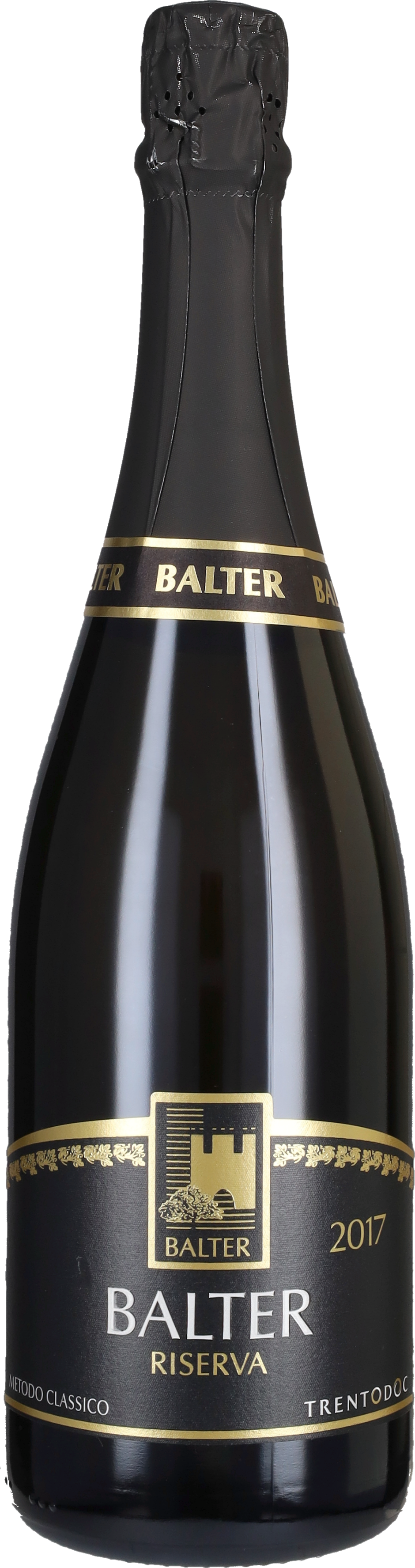
Trento Spumante Pas Dosé Riserva Balter 2017The Pas Dosé Riserva Trento Spumante Balter is a vintage in which complexity and expressiveness derive from two precise choices made by the winery. First of all, the period of ageing spent on yeasts, intentionally long precisely to emphasize the personality of this Metodo Classico, then the vinification, which in part also takes place in the wood, thus enriching the overall profile of the Riserva and its aromatic set. The choice to let them speak a territory highly suited to the creation of bubbles, such as that of Trento, is expressed in the decision to"not dose"the final product, making a sip that makes authenticity its calling card. This Trento Spumante Pas Dosé Riserva Balter comes from a blend in which, in addition to 80% Chardonnay, we find 20% Pinot Noir. The vines grow in plots with a hilly profile, where the soils are of morainic origin, characterized by the presence of clay and limestone rocks. The first fermentation of the must take place partly in steel and partly in small oak barrels. Second fermentation then takes place in the bottle, following the production principles of the Metodo Classico, and the Spumante lies on the lees in the bottle for 48 months. At the end of this maturation, the Balter team proceeds with the disgorging and bottling operations. Importantly, no dosage of liquor is added at this stage. The Trento Spumante Pas Dosé Riserva Balter develops in the glass with a beautiful straw colour; the perlage that can be seen at sight is characterized by the fine grain of the bubbles, endowed with good persistence. The nose opens on citrus and floral tones, which develop with linearity and elegance, denoting a pleasant balance. In the mouth, it presents itself with an excellent body, fasciant and dynamic thanks to a taut sip, crisp from a gustatory point of view, in which the flavour of the mineral whisks once the drink is finished is pleasant. A label that comes from a very careful selection of grapes in the vineyard and, for this very reason, sees the light only in vintages in which every berry is able to meet the quality standards sought by the winery.47,00 £*Shipping: 48,00 £Secure redirect to the provider


-
Can champagne expire?
Champagne does not necessarily expire in the same way that food or other perishable items do. However, it can lose its flavor and quality over time if not stored properly. Champagne should be stored in a cool, dark place and kept away from temperature fluctuations and light exposure. If stored correctly, champagne can last for several years and even improve in flavor with age. **
-
Does it say Je n'aime pas le chocolat or Je n'aime pas de chocolat?
The correct phrase is "Je n'aime pas le chocolat." This means "I don't like chocolate." The use of "le" indicates a specific, definite object, in this case, "the chocolate." Using "de" in this context would not be grammatically correct. **
-
Can champagne go bad?
Yes, champagne can go bad if it is not stored properly. Exposure to light, heat, or fluctuations in temperature can cause champagne to spoil. Additionally, if the cork is not sealed tightly or if the bottle is stored upright, the champagne can oxidize and lose its flavor. It is best to store champagne in a cool, dark place on its side to keep it fresh for longer. **
-
What percentage is the champagne glass on the left filled, when the champagne...
The champagne glass on the left is filled to approximately 60% when the champagne is poured to the level shown in the image. This estimation is based on the visual representation of the glass and the amount of champagne in it. The glass appears to be filled just over halfway, indicating that it is around 60% full. **
Which champagne is the sweetest?
The sweetest type of champagne is typically labeled as "demi-sec." Demi-sec champagnes have a higher sugar content compared to other varieties like brut or extra brut. These champagnes are known for their sweeter taste profile, making them a popular choice for those who prefer a dessert-like champagne. **
What is a champagne shower?
A champagne shower is a celebratory act where bottles of champagne are shaken and then sprayed over a crowd of people, typically at a party or event. It is a symbol of extravagance and luxury, often associated with high-profile celebrations such as winning a championship or a major achievement. The act of being showered in champagne is seen as a sign of success and is often captured in photos and videos as a memorable moment of jubilation. **
Top-Angebote
Products related to Champagne-Pas-Dosé-Réserve:
-
Champagne Pas Dosé 'Réserve Perpétuelle' PhilipponnatPhilipponnat's Pas Dosé 'Réserve Perpétuelle' Champagne represents, in the name of purity, the style of the historic Maison in Mareuil-sur-Ay, founded way back in 1522. The labels in the Perpétuelle line are a Cuvée Prestige, made with a selection of high-quality grapes from vineyards classified as Premier or Grand Cru. The blend is composed of a majority of Pinot Noir, complemented by Chardonnay and a small amount of Meunier. It is an elegant and intense Champagne which, thanks to long ageing on the lees and the use of reserve wines, offers a mature and complex bouquet, supported by the typical mineral freshness of a great terroir.Pas Dosé 'Réserve Perpétuelle' is produced by a Maison that has preserved the ancient artisanal savoir-faire of the art of Champagne over the centuries. Philipponnat manages a splendid domaine of about twenty hectares, with vineyards cultivated in the municipal territories of the villages of Mareuil-sur-Ay, Ay, Mutigny and Avenay. It is a classic cuvée, made with the Maison's best Premier Cru and Grand Cru parcels. The grapes from the individual vineyards are pressed very gently and vinified separately in stainless steel tanks. After several months of ageing, the vins clairs of the vintage undergo partial malolactic fermentation and are blended with 20-30% reserve wines, aged in wooden barrels using the solera method, to give the Champagne greater maturity and expressive complexity. The second fermentation takes place in the bottle according to the Champenoise method, with a period sur lattes of at least 36 months before dégorgement.The 'Réserve Perpétuelle' Pas Dosé is a Champagne dedicated to lovers of bottles with a pure and essential character, allowing them to appreciate the extraordinary quality and maturity of the grapes. It is the perfect label to enjoy as an aperitif, with seafood or to accompany appetisers or a plate of sushi and sashimi. In the glass, it is a bright light yellow colour with light golden reflections that illuminate its appearance. The perlage is delicate, with great finesse and persistence. The nose reveals a refined and elegant bouquet, with aromas of lime zest, citrus fragrances, hawthorn blossom, orange blossom, white fruit, green apple and hints of freshly baked bread crust. The palate is taut and vertical, with intense depth of flavour, which unfolds harmoniously with chiselled nuances of remarkable richness and aromatic persistence. The finish is clear and dry, closing with savoury notes and vibrant freshness.51,00 £*Shipping: 48,00 £Secure redirect to the provider
-
Franciacorta Pas Dosé 'Sublimis' Uberti 2019The Sublimis Pas Dosé is the splendid interpretation of Franciacorta by the Umberti winery. Even from the name, one can sense the quality of these bubbles, created by those who have been present in the area since the Eighteenth century, like the Uberti family. The winery dates back to much more recent times when, in 1978, Agostino Uberti made his first vintage, then destined for the production of the Metodo Classico. In thirty-five years of history, the winery has gained experience and, just as then, Agostino along with his wife and daughters manages the vineyards with great care. Mechanical weeding and only natural fertilization help to keep intact the precious qualities of the soils of Erbusco, thus contributing to create some of the richest and most complex wines that the denomination can boast. Like the Franciacorta Sublimis Pas Dosé, born from carefully selected grapes, a model of indomitable elegance capable of providing tastings of the highest level. The emblem depicted on the label, in which the starry sky is precious preserved in a frameof gold, is a tribute to the night freshness that gives the chardonnay grapes a perfect ripening, making them shine in the sun with their perfectly golden berries. With a fine and refined perlage, the Franciacorta Sublimis Pas Dosé Umberti is majestically intense: it conquers with its noble balance in which a rainbow of aromas parades on the palate without ever ceasing to amaze. A wonderful expression of the Franciacorta territory.49,00 £*Shipping: 48,00 £Secure redirect to the provider
-
Franciacorta Pas Dosé Zero Vigneti CenciVigneti Cenci's Franciacorta Pas Dosé Zero is a bubbly with a dry and taut style, an expression of great purity being produced without any dosage. The headquarters of the winery is La Boscaiola, a beautiful 17th-century farmhouse located within the municipality of Cologne, at the south-western end of the Franciacorta production area. In this area, characterised by excellent exposure, an ideal microclimate for the cultivation of vines and soils particularly rich in mineral substances, wine production has always represented an activity of primary importance, carried on today by Giuliana Cenci together with her son Maurizio Bassi.Pas Dosé Zero Vigneti Cenci Franciacorta originates from a blend of Chardonnay (70%) and Pinot Bianco (30%) grapes grown within the municipality of Cologne, specifically on the slope of Monte Orfano. The soil is formed by an ancient, stepped colluvial layer on a rocky substratum of conglomerate gravels while the exposure is south-west. In the cellar, the grapes are vinified by soft pressing and subsequent alcoholic fermentation of the must at a controlled temperature. This is followed by re-fermentation in the bottle according to the Metodo Classico, using only sugars from the grapes rather than exogenous sugars. After at least 36 months of maturation on the lees, the sparkling wine is finally disgorged and then topped up with the same wine, without any dosage.Franciacorta Vigneti Cenci Pas Dosé Zero has a straw-yellow colour with greenish highlights and subtle effervescence. The nose has pleasant aromas of citrus fruits such as grapefruit and citron, supported by notes of pear and wisteria and a fine iodine mineral vein. Very savoury and energetic on the palate, characterised by an almost citrine freshness and a taut, distinctly mineral finish.28,00 £*Shipping: 48,00 £Secure redirect to the provider
-
What does "j'ai pas" or "je ne sais pas" mean?
"J'ai pas" is a colloquial way of saying "I don't have" in French, where the word "pas" replaces the word "de." On the other hand, "je ne sais pas" means "I don't know." Both phrases are commonly used in everyday conversations in French-speaking countries. **
-
What is the difference between c'est pas and ce n'est pas?
The difference between "c'est pas" and "ce n'est pas" lies in their formality. "C'est pas" is a colloquial and informal way of saying "it's not" in French, while "ce n'est pas" is the formal and standard way of expressing the same idea. "C'est pas" is commonly used in spoken language and informal writing, while "ce n'est pas" is more appropriate for formal writing and polite speech. **
-
Can champagne expire?
Champagne does not necessarily expire in the same way that food or other perishable items do. However, it can lose its flavor and quality over time if not stored properly. Champagne should be stored in a cool, dark place and kept away from temperature fluctuations and light exposure. If stored correctly, champagne can last for several years and even improve in flavor with age. **
-
Does it say Je n'aime pas le chocolat or Je n'aime pas de chocolat?
The correct phrase is "Je n'aime pas le chocolat." This means "I don't like chocolate." The use of "le" indicates a specific, definite object, in this case, "the chocolate." Using "de" in this context would not be grammatically correct. **
Similar search terms for Champagne-Pas-Dosé-Réserve
-
Spumante Metodo Classico Pas Dosé Kettmeir 2021Lo Spumante Metodo Classico Pas Dosé della cantina altoatesina Kettmeir è un’etichetta che ben rappresenta il carattere del territorio. Ha la particolarità di essere realizzato con una percentuale molto elevata di Pinot Bianco, che dona un carattere di originale morbidezza ed eleganza, integrata da Chardonnay e da una piccola percentuale di Pinot Nero. Proprio la composizione dell’assemblaggio, la perfetta maturità delle uve e il lungo affinamento sur lattes, consente di realizzare un dosaggio zero armonioso e di grande equilibrio gustativo. Il Metodo Classico Pas Dosé nasce grazie all’esperienza di una cantina storica dell’Alto Adige. Kettmeir si trova nella zona di Caldaro e gestisce circa 50 ettari di vigneti in diverse aree del territorio altoatesino. Le uve di Pinot Bianco, Chardonnay e Pinot Nero provengono da vigneti aziendali coltivati sulle alte colline dell’Oltradige e della Bassa Atesina, a un’altitudine compresa tra i 380 e i 700 metri sul livello del mare. Il clima è fresco, connotato da importanti escursioni termiche tra le giornate soleggiate e le notti fredde. I terreni sono prevalentemente di natura calcarea, con presenza di argilla e molto ricchi di scheletro. Al termine della vendemmia, le uve sono sottoposte a refrigerazione per una notte e quindi alla vinificazione, che avviene separatamente per ogni vitigno. I grappoli sono pressati in modo molto delicato e il mosto fiore fermenta in vasche d’acciaio inox a temperatura controllata. I vini base maturano in acciaio fino alla primavera successiva, quando viene creata la cuvée definitiva. La seconda fermentazione si svolge in bottiglia secondo il Metodo Classico, con un affinamento sui lieviti di almeno 40 mesi. Il Pas Dosé Metodo Classico di Kettmeir è uno Spumante dal profilo verticale, teso e austero, ideale per chi ama soprattutto la limpida freschezza minerale. Nel calice si presenta con una veste di colore giallo paglierino con leggeri riflessi dorati e un perlage sottile, delicato e persistente. Il bouquet è elegante e raffinato, con fragranze agrumate, sfumature di fiori bianchi, aromi di frutta a polpa bianca, mela verde, pesca, cenni di erbe aromatiche, frutta secca, crosta di pane, leggere note di zenzero e spezie bianche. Al palato è intenso e ricco, con un sorso cremoso e sapido, che si allunga profondo ed essenziale verso un finale secco, molto fresco e persistente.38,00 £*Shipping: 48,00 £Secure redirect to the provider
-
Trento Spumante Pas Dosé Riserva Balter 2017The Pas Dosé Riserva Trento Spumante Balter is a vintage in which complexity and expressiveness derive from two precise choices made by the winery. First of all, the period of ageing spent on yeasts, intentionally long precisely to emphasize the personality of this Metodo Classico, then the vinification, which in part also takes place in the wood, thus enriching the overall profile of the Riserva and its aromatic set. The choice to let them speak a territory highly suited to the creation of bubbles, such as that of Trento, is expressed in the decision to"not dose"the final product, making a sip that makes authenticity its calling card. This Trento Spumante Pas Dosé Riserva Balter comes from a blend in which, in addition to 80% Chardonnay, we find 20% Pinot Noir. The vines grow in plots with a hilly profile, where the soils are of morainic origin, characterized by the presence of clay and limestone rocks. The first fermentation of the must take place partly in steel and partly in small oak barrels. Second fermentation then takes place in the bottle, following the production principles of the Metodo Classico, and the Spumante lies on the lees in the bottle for 48 months. At the end of this maturation, the Balter team proceeds with the disgorging and bottling operations. Importantly, no dosage of liquor is added at this stage. The Trento Spumante Pas Dosé Riserva Balter develops in the glass with a beautiful straw colour; the perlage that can be seen at sight is characterized by the fine grain of the bubbles, endowed with good persistence. The nose opens on citrus and floral tones, which develop with linearity and elegance, denoting a pleasant balance. In the mouth, it presents itself with an excellent body, fasciant and dynamic thanks to a taut sip, crisp from a gustatory point of view, in which the flavour of the mineral whisks once the drink is finished is pleasant. A label that comes from a very careful selection of grapes in the vineyard and, for this very reason, sees the light only in vintages in which every berry is able to meet the quality standards sought by the winery.47,00 £*Shipping: 48,00 £Secure redirect to the provider
-
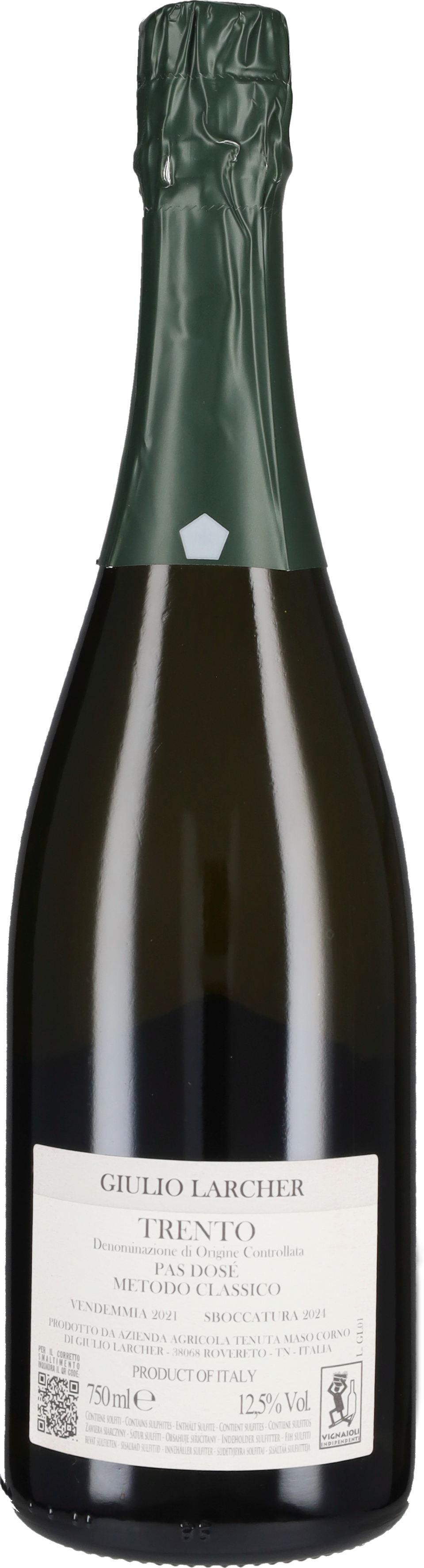
Trento Spumante Pas Dosé Tenuta Maso Corno 2021The Spumante Trento Pas Dosé signed Tenuta Maso Corno is a pure Chardonnay, a Blanc de Blanc therefore, endowed with a fruity and mineral aromatic profile. It is the first Trento DOC produced by Giulio Larcher, a young entrepreneur who started the story of Tenuta Maso Corno in 2006 after purchasing 5 hectares of vineyards located around an old farmhouse on the slopes of the Lessini Mountains. In a short time, thanks to a production approach centred on quality, Giulio's wines have enjoyed international success, reaching important foreign markets such as Japan, the Netherlands and Russia.Tenuta Maso Corno Spumante Trento Pas Dosé originates solely from Chardonnay grapes grown on 30-year-old vines rooted on dolomitic-calcareous soils at analtitude of between 500 and 800 metres above sea level. The grapes, hand-picked and carefully selected, undergo a soft pressing, followed by alcoholic fermentation in stainless steel tanks. Malolactic fermentation is not carried out, in order to preserve all the freshness of the sparkling wine base, which after a short rest in stainless steel is subjected to bottle fermentation in accordance with the Metodo Classico. Maturation on the lees lasts for at least 30 months, at the end of which the sparkling wine undergoes disgorgement and subsequent topping up with the same wine, without any dosage.The Trento Pas Dosé Spumante of Tenuta Maso Corno has a straw yellow colour with fine bubbles. The nose has aromas of white-fleshed fruit, such as pear, followed by mineral hints of flint and hints of pastry and bread crust on the finish. In the mouth it is very fresh and savoury, characteristics that give a vertical dimension to this sparkling wine, anticipating the fine and distinctly mineral finish.34,00 £*Shipping: 48,00 £Secure redirect to the provider
-
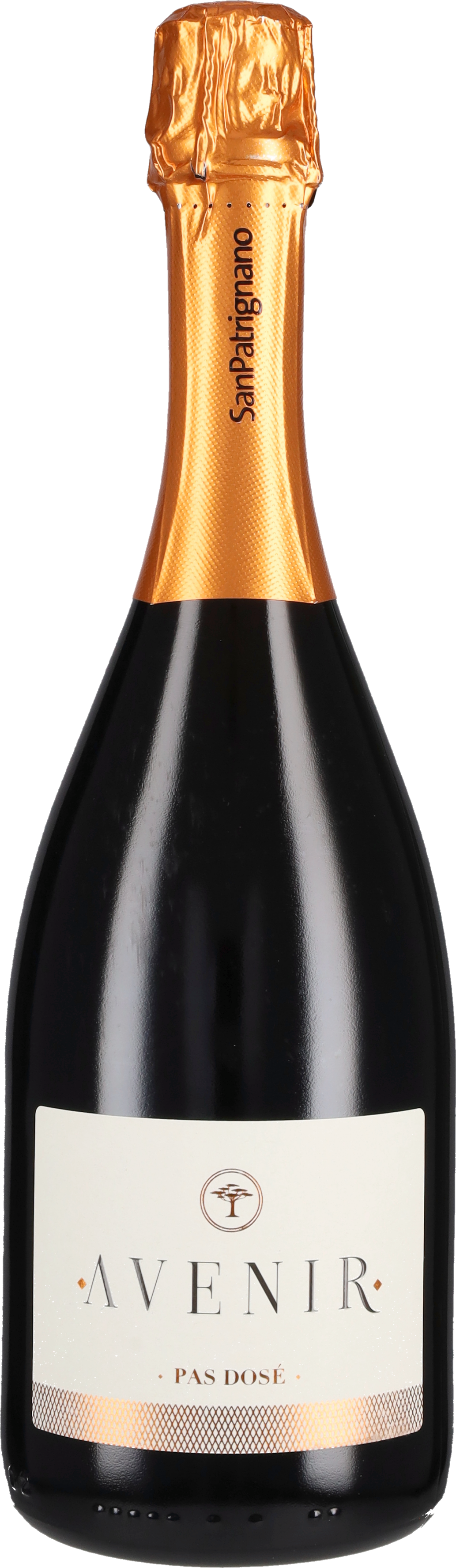
Spumante Metodo Classico Pas Dosé 'Avenir' San PatrignanoSan Patrignano's Spumante Metodo Classico 'Avenir' Pas Dosé is a bubbly made only from Pinot Noir grapes, a Blanc de Noir therefore, that stands out for its dry and taut taste, the result of the decision to exclude any dosage. The appellation 'Avenir' comes from the French and means "future", chosen to symbolise the ambitious challenge undertaken by San Patrignano in the fine production of a Metodo Classico sparkling wine, thus completing the winery's range of labels.Spumante 'Avenir' San Patrignano Metodo Classico Pas Dosé is made from pure Pinot Noir grapes harvested during the first week of August in order to bring grapes with a high organic acid content to the winery. Vinification follows by direct pressing of the whole bunches and subsequent alcoholic fermentation of the must at a controlled temperature in stainless steel tanks. In the spring following the harvest, bottle-drawing according to the Metodo Classico is then carried out, combined with a long ageing period of 36 months on the lees. After this period, the sparkling wine is finally disgorged and then filled with the same wine, thus excluding any dosage.On visual inspection, San Patrignano's Metodo Classico Spumante Pas Dosé 'Avenir' reveals a brilliant straw yellow colour with a fine, lively effervescence. The aromatic bouquet expresses pleasant hints of small red fruits, almonds and red wild flowers, enriched by evocative and fragrant notes of bread crust. The taste combines marked freshness and excellent creaminess in a taut, vertical development of excellent balance, characterised by a dry finish. This Metodo Classico is ideal for celebrating festive moments, excellent as a refined aperitif or at the table, paired with seafood or land-based hors d'oeuvres.20,00 £*Shipping: 48,00 £Secure redirect to the provider
-
Can champagne go bad?
Yes, champagne can go bad if it is not stored properly. Exposure to light, heat, or fluctuations in temperature can cause champagne to spoil. Additionally, if the cork is not sealed tightly or if the bottle is stored upright, the champagne can oxidize and lose its flavor. It is best to store champagne in a cool, dark place on its side to keep it fresh for longer. **
-
What percentage is the champagne glass on the left filled, when the champagne...
The champagne glass on the left is filled to approximately 60% when the champagne is poured to the level shown in the image. This estimation is based on the visual representation of the glass and the amount of champagne in it. The glass appears to be filled just over halfway, indicating that it is around 60% full. **
-
Which champagne is the sweetest?
The sweetest type of champagne is typically labeled as "demi-sec." Demi-sec champagnes have a higher sugar content compared to other varieties like brut or extra brut. These champagnes are known for their sweeter taste profile, making them a popular choice for those who prefer a dessert-like champagne. **
-
What is a champagne shower?
A champagne shower is a celebratory act where bottles of champagne are shaken and then sprayed over a crowd of people, typically at a party or event. It is a symbol of extravagance and luxury, often associated with high-profile celebrations such as winning a championship or a major achievement. The act of being showered in champagne is seen as a sign of success and is often captured in photos and videos as a memorable moment of jubilation. **
* All prices are inclusive of VAT and, if applicable, plus shipping costs. The offer information is based on the details provided by the respective shop and is updated through automated processes. Real-time updates do not occur, so deviations can occur in individual cases. ** Note: Parts of this content were created by AI.